Emotional Based School Avoidance
In Milton Keynes we are seeing an increase in children and young people experiencing difficulty in attending school due to emotional reasons, like anxiety.
This has led to the development of the EBSA Project group in Milton Keynes.
For information, training and resources related to EBSA, please see our new dedicated page Emotionally Based School Avoidance (EBSA) page.
Making Connections Project
The Making Connections project supports schools to become more attachment-aware and trauma-informed in their practice. Funded by Milton Keynes Virtual School and delivered in partnership with the Educational Psychology Service (EPS), the project was first launched with a cohort of 20 schools during the 2024-2025 academic year. Each year, schools are invited to apply, with approximately 20 schools offered a place on the programme.
Participating schools receive a range of support from the EPS, starting with the development of a bespoke action plan through the PATH (Planning Alternative Tomorrows with Hope) process. Schools also have access to a variety of training opportunities covering topics such as trauma, attachment and resilience, restorative approaches, the teen brain, harmful sexual behaviours, contextual safeguarding and emotion coaching. In addition, each school is allocated one day of EP support to further develop confidence and capability in an area of trauma-informed practice that is most relevant to their setting and priorities.
Schools are also invited to attend regular network meetings, jointly facilitated by Milton Keynes Virtual School and the EPS. These meetings provide opportunities to share effective practice, reflect on progress, and explore ways to further embed attachment-aware and trauma-informed approaches within their school communities.
Upon successful completion of the first year of the project, schools are eligible to achieve the Bronze Award from the Attachment Research Community (ARC). Schools that achieve the Bronze Award can choose to continue their journey towards the Silver and Gold Awards, by undertaking further development activities such as action research projects and sharing their learning locally, regionally, and nationally.
For information including testimonials and sign-up process, please visit the Making Connections page: Making Connections
For a brief overview of the project: MC EP support overview.
For more information on the ARC pathway and awards please see: The ARC Pathway | ARC
For a summary of the pilot year's impact please see: MCP pilot year infographic
The Language Intervention Programme
The Language Intervention Programme and assessment materials are aimed at Early Years classes.
LIPs aims to enhance children’s language development through a targeted group intervention based on simple enrichment activities. It is designed to build children’s vocabulary by providing structured practice in speaking and listening. It is straight forward to run, fits into a busy timetable and is ideal for children starting school.
In the evaluation (2018), children who participated showed significant improvements in their expressive vocabulary. Groups included shy children and those with English as an additional language, as well as those with language delay. Feedback from teachers and teaching assistants running the intervention indicated they appreciated having a simple structured intervention to boost children’s language attainments. They found the approach fitted in well with other learning activities in the classroom and was easy to organise.
Cost: £30 per set (which includes a manual and assessment materials)
To order: please email education.psychology@milton-keynes.gov.uk
Order form: download here
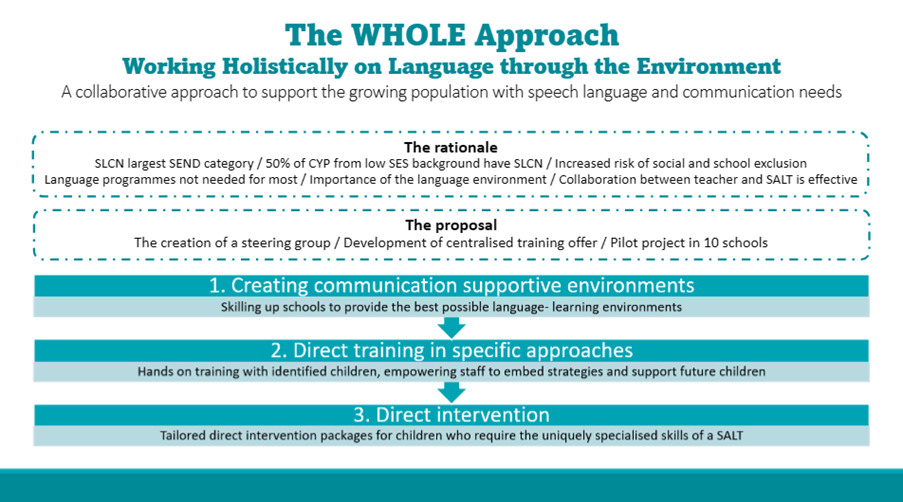
The WHOLE Approach Project
Supporting Speech, Language and Communication in Schools
The WHOLE Approach focuses on strengthening speech, language and communication (SLC) across the whole school community through training and coaching delivered by Speech and Language Therapy (SaLT).
Speech, language and communication needs (SLCN) are the most common type of SEND, but not all SLCN need specialist input from a Speech and Language Therapist. In Milton Keynes, and across the country, rising demand for referral to specialist SaLT services means that many children are not receiving help early enough, particularly those with less visible needs. Most children’s needs can be met by in-school strategies and approaches, and they will make progress without the need for specialist input.
The WHOLE Approach aims to address this by building capacity within schools, ensuring that all children and young people can develop strong communication skills as part of everyday practice.
Key Features
- A Whole-school approach to communication-friendly environments
- Training and coaching delivered by SaLT professionals
- Working in partnership with the educational psychology service
- Focus on universal and targeted provision within everyday practice
Who It Supports
The project is designed to benefit:
- Children with identified SLCN
- Children with less obvious or unidentified needs
- Pupils whose SLCN are linked to disadvantage or vulnerability
- The wider school community, including staff and families
Impact and Benefits
- Improved communication environments across schools
- Earlier identification of SLCN
- Reduced reliance on specialist services
- Enhanced inclusion and participation
- Better educational and life outcomes for children and young people
Prevention Focus
The WHOLE Approach plays a central role in the prevention agenda by strengthening universal and targeted provision, helping to ensure needs are met early and effectively within everyday school practice.
Project evaluation
The WHOLE Approach includes an ongoing, interagency evaluation supported by the Educational Psychology Service and informed by a multi-agency steering group, comprising schools, Local Authority representatives and the Parent Carer Alliance.
The evaluation is being carried out with a range of schools in Milton Keynes to understand how the approach is working in practice and its impact in school environments and outcomes for children and young people. Findings from this work will inform future development across Milton Keynes.
For more information: please email education.psychology@milton-keynes.gov.uk